COCONUT SHELL CARBON BLOCKS
Coconut shell carbon blocks engineered for the finished system.
Carbon origin matters, but a reliable block also depends on particle distribution, binder ratio, density, geometry and the test conditions used to approve it.
 OEM
OEMQUICK ANSWER
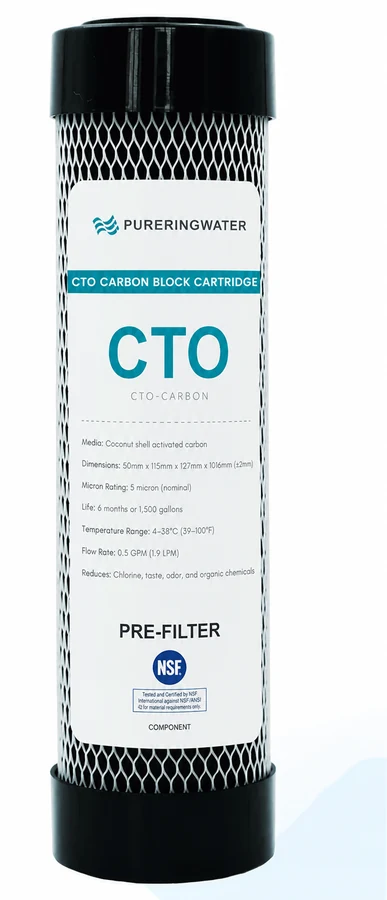
PureRing Water develops coconut-shell activated carbon blocks for standard housings and custom OEM systems. Projects can begin from a target specification, drawing, incumbent data sheet or physical sample.
Why coconut shell carbon?
Coconut shell activated carbon is widely used in drinking-water filters because its pore structure can be well suited to many taste, odor, chlorine and selected organic-reduction applications. Carbon source alone does not guarantee finished-filter performance; activation, washing, particle size and block construction still need to match the water challenge.
- Carbon origin and batch identification
- Ash, moisture, pH and applicable adsorption indicators
- Particle-size distribution and fines control
- Project-specific media or additive options
From carbon powder to a controlled block
The finished carbon block is a coupled system. Finer media and tighter structures can increase contact and particle control, but may also increase pressure drop. Binder, density, wall thickness, core size and sealing design must be evaluated together.
- Dimensions, weight, density and roundness
- Dry and wet physical integrity
- Initial and life-cycle pressure drop
- Flush behavior and carbon-fines release
What OEM buyers should qualify
A useful approval plan compares candidate and incumbent filters under one protocol. Specify the same housing, inlet water, flow, pressure, challenge concentration, endpoint and sampling schedule.
- Rated flow and pressure range
- Chlorine or other agreed treatment-capacity curve
- Variation across multiple production batches
- Exact model, document and certification scope
Formats and finishing
Standard and custom programs can cover slim and large-format housings, different lengths and diameters, end caps, gaskets, outer wraps, labels and packaging. Final availability is confirmed against the drawing and annual volume.
FREQUENTLY ASKED QUESTIONS
Questions buyers ask before sampling.
Is every coconut shell carbon block the same?
No. Carbon origin is only one variable. Activation, washing, particle profile, binder, density, geometry and test conditions can materially change the finished block.
Can you match an existing carbon block specification?
A second-source project can begin from a data sheet, drawing or sample, followed by dimensional review, sampling and like-for-like benchmarking.
Do iodine value and CTC prove cartridge performance?
They are useful media indicators, but they do not replace finished-filter pressure-drop, flush, capacity and contaminant-reduction testing.
Which sizes are available?
Common 10-inch, 20-inch, slim and large-format directions are supported, with custom dimensions reviewed project by project.
TALK TO THE MANUFACTURER
Turn the selection into a testable specification.
Send the housing, rated flow, water challenge, current data sheet or sample and destination market.
Send a technical brief