CARBON BLOCK SELECTION GUIDE
1 micron vs 5 micron carbon block: finer is not automatically better.
Micron direction affects physical filtration and hydraulic resistance, but it does not by itself define adsorption capacity, service life or a certified contaminant claim.
 GUIDE
GUIDEQUICK ANSWER
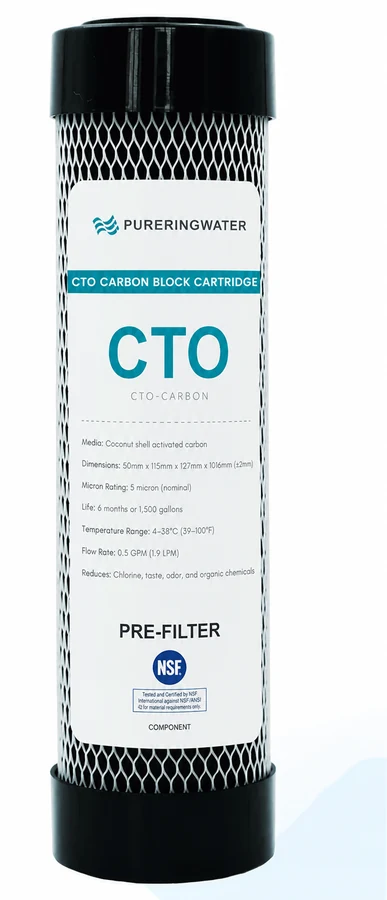
A 1-micron carbon block generally targets finer particle control than a 5-micron direction, while a 5-micron block may offer more tolerance for flow and sediment. The correct choice depends on rated flow, available pressure, pretreatment and the complete test protocol.
SIDE-BY-SIDE
Compare the engineering tradeoffs.
| Decision factor | 1-micron direction | 5-micron direction |
|---|---|---|
| Particle target | Finer nominal particle control | Broader particle control |
| Pressure-drop risk | Usually requires closer hydraulic review | Often provides more flow tolerance |
| Sediment sensitivity | May load sooner without suitable pretreatment | Can be more forgiving in prefilter service |
| Typical starting use | Finer POU and claim-led development | RO prefilter and standard CTO programs |
| Proof required | Model-level curve and relevant claim test | Model-level curve and relevant claim test |
Nominal and absolute are not interchangeable
A micron number must be read with its definition and test method. Nominal retention, absolute retention and a certified particulate or cyst claim are different statements. Ask how the number was measured.
Finer structure changes hydraulics
Reducing pore direction can raise initial pressure drop and make the cartridge more sensitive to sediment loading. Available inlet pressure, required flow and the rest of the filter train need to be checked together.
Micron does not define adsorption capacity
Chlorine, chloramine or organic-reduction capacity also depends on carbon chemistry, mass, pore distribution, contact time and challenge conditions. A 1-micron label alone does not prove higher adsorption capacity.
How an OEM should choose
Define the particle objective, rated flow, clean pressure-drop limit, source-water sediment, upstream prefilter, replacement interval and any certification claim. Then test more than one batch in the intended housing.
FREQUENTLY ASKED QUESTIONS
Questions buyers ask before sampling.
Does 1 micron remove more chlorine than 5 micron?
Not necessarily. Micron direction relates mainly to physical structure; chlorine capacity also depends on carbon chemistry, mass, contact time, flow and challenge conditions.
Will a 1-micron block reduce flow?
It can create more hydraulic resistance, but actual flow depends on the complete block geometry, pressure, housing and sediment loading. Use a model-level pressure-drop curve.
Is a 1-micron rating the same as cyst certification?
No. A micron statement does not automatically establish a certified cyst-reduction claim. Verify the exact standard, model and official listing.
Which is better before an RO membrane?
The choice depends on sediment pretreatment, chlorine target, flow and available pressure. A 5-micron CTO is a common starting direction, but the complete RO system must be validated.
TALK TO THE MANUFACTURER
Turn the selection into a testable specification.
Send the housing, rated flow, water challenge, current data sheet or sample and destination market.
Send a technical brief